Sunday, March 25, 2012

Foraging Habits

As solitary animals, tigers generally hunt alone rather than in groups.  They are carnivorous animals who prefer to live in areas with dense vegetation to aid in their hunting as well as for their own protection.  Tigers do most of their hunting at night, where they primarily rely on their hearing and eyesight to locate their prey.  They crouch and quietly stalk their prey until they can situate themselves near enough to launch an ambush.  This stalking approach seems to be a way to save energy, since chasing down an animal is a much greater exertion.  They kill their prey with a bite to the neck or throat.  

Tigers like to drag their kill to an at least semi-covered area before they begin to eat.  With each kill, tigers eat an excessive amount and can then go for days without eating again.  This is beneficial because attacks are usually successful only once every 10-20 times.  This seems to be the trade-off for hunting alone.  Tigers get to eat their heart's content when they do get a kill, but they can't rely on a meal every day.  Interestingly, once tigers are finished with their meal, they cover up the remains in an attempt to hide it from other animals who may benefit from the leftovers. 

Female tigers with cubs must hunt more often to keep their cubs fed.  Though it isn't a regular occurrence, male tigers have been documented sharing their kill with a female and her cubs.  It doesn't seem to be clear why some males do this at certain times, but it is likely only in times of abundant resources.   

Wednesday, March 21, 2012

Territorial Behavior

Tigers are solitary animals and highly territorial.  They primarily live in home ranges that often overlap with a number of female home ranges, but exclude other males.  Female tigers usually remain within the same home range for their lifetime, but male tigers may establish new home ranges over the years.  Sometimes, tigers establish their own territories, which don't overlap with any others.  This decision primarily depends on the amount of prey in the area, which also influences the size of tigers' home ranges or territories.  Areas with a dense population of prey show smaller home ranges, but male tigers consistently have larger territories than females. 

Female tigers tend to establish themselves near the territory they grew up in, while male tigers set out on their own.  They either find an area not already occupied by other tigers, or challenge another tiger for the territory he has already established.  
In situations where tigers have home ranges rather than clear territories, they use intimidation rather than aggression when confronted with another male within their range.  Often, the intruding tiger with display a subordinate posture and the dominant tiger will allow him to stay in the range, as long as he keeps his distance.


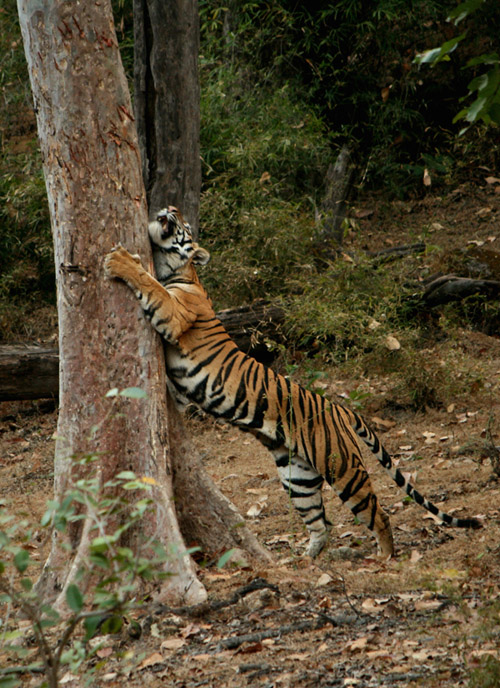
Tigers mark their territory with scent and visual cues.  The most basic means of scent marking is urinating on trees or rocks surrounding the boundary of the territory.  Tigers produce a unique type of urine with a longer lasting scent for this purpose.  They also visually establish their territory by scraping out marks along the boundary.  


Monday, March 12, 2012

Tigers in Entertainment

Since beginning this blog, I've begun to notice tigers in commercials and movies.  Given their solitary nature and  the obvious danger they can pose to humans, I wondered how difficult it is to train these animals.  When I began to research this, I found that there doesn't seem to be a scarcity of companies with trained tigers available for Hollywood.  Therefore, it seems that it can't be so overly risky or difficult that few can manage it.

  However, I found an interview with a professional tiger trainer, Dave Salmoni, who said that most trainers of big cats are eventually attacked.  He even said, "They will kill you if they get a chance.  They may share some of your emotions, but they won't have any problem with killing you if you make a mistake.  My cats will kill me, no problem, given the chance."  This reminded me of the Sigfried and Roy accident in 2003, when one of the male tigers attacked Roy.  There is still debate about whether the cat intended to hurt Roy or not, but either way, it proves that tigers are still wild animals, no matter how they are trained.


Yet many obviously continue to work with and train tigers for entertainment.  Michael Hackenberger, another longtime big cat trainer, says problems arise when handlers "refuse to accept the biological realities of big cats."  These animals do not form bonds with humans.  In fact, they don't even make lasting bonds with other tigers.  As long as handlers respect the boundary between them and the animals and take the necessary precautions, it seems that it is still possible to work with tigers.  Still, I would not want to be the one acting beside it.


Here are a few clips of tigers in entertainment.  


(A slightly less realistic depiction)

Resources:

Monday, February 27, 2012

Reproductive Behavior

Tiger subspecies are spread out over differing regions and climates, which effects patterns of reproduction. Thus, the following is an outline of the basic characteristics of reproductive behavior found across tiger subspecies, but specific details may vary between subspecies.  Female tigers reach sexual maturity around 3-4 years of age, while male tigers do not reach this point until they are 4-5.  Once reaching maturity, female tigers signal that they are in heat (which occurs most frequently during the cooler months) in a variety of ways, including secreting a specific scent and attracting attention through roaring and other noises.  These behaviors are meant to attract potential mates, who approach the tigress warily.  Tigers are solitary creatures and therefore require a slower mating process while they ascertain that no harm will befall them.  In some instances, tigers will fight over a mate both have claimed.  These fights continue until one tiger gives up or dies.  Tigers do not mate for life and take many different partners.  An interesting fact about female tigers is that they do not release an egg to be fertilized until mating has already begun.  


Once a female is pregnant, the male tiger is out of the picture and the tigress must take sole responsibility for her young.  The female tiger's gestation period is four months and the general size of the litter is approximately 3 to 4 cubs.  Female tigers care for their cubs until they are around 2 years old.  Because tiger cubs stay with their mothers for so long, there is usually a 2 year gap between births.


Photos: 

References:

Monday, February 20, 2012

Zoo Visit

This past weekend I visited the San Diego Zoo and spent some time at the tiger exhibit.  Below is a picture I took of the tiger, who was surprisingly active during my visit.  In my previous experience, tigers at zoos and wild animal parks have always been fairly reclusive and difficult to observe.  This time, however, the tiger was trotting around and sat down right in front of us to chew a large bone.

It is my opinion that the San Diego Zoo does it's best to provide adequate living conditions for its animals, but any kind of captivity for wild animals seems less than ideal.  The exhibit for the tiger hardly seems spacious enough to allow for such a large, powerful animal to get a sufficient amount of exercise and exploration.  However, I understand the work many zoos do to help protect endangered species, which include all subspecies of tiger.  I trust that those who work at the zoo and design exhibits take into account what is in the best interest of the animals and hope that every animal in captivity is treated with respect and allowed the chance to live as naturally as possible.

Sunday, February 5, 2012

Welcome!

On the off chance that anyone outside of Animal Psych reads this blog, let me explain what'll be going on here.  If the title wasn't clear enough, this blog's aim is to inform the reader on many different aspects of the tiger species. They've always been my favorite zoo animal, so I'm taking this opportunity to learn something about these animals beyond how cute they are.  I can't pretend that I know much yet, but we're going to learn together. To start us off, take a look at a few pictures to familiarize yourself with our topic of interest.  Next week I'll be back to dive into a little history of these great cats. Thanks for reading!


Photos: (1) http://en.wikipedia.org/wiki/Tiger  (2) http://www.mylot.com/w/photokeywords/tigers.aspx  (3) http://www.sodahead.com/fun/orange-tigers-or-white-tigers/question-2412749/?link=ibaf&q=&imgurl=https://blogger.googleusercontent.com/img/b/R29vZ2xl/AVvXsEi_LmT9ssNfDVFstwVvLnit0smqJIxcwxk2n6Di4mw5BW8umLAXj-lKIJYYArpuinVtKYxX9thqfhcIOZYveHQpjpX6wo8yBxy9fvkPUJ-S3toEf6add3CjvSAwrAKxiXAqjxXl7q_T4ME/s1600/baby%252Bwhite%252Btiger%252Bwallpaper%252B1.jpeg